Tax wealth not work.
We can stop growing wealth inequality.
We use cookies where necessary to allow us to understand how people interact with our website and content, so that we can continue to improve our service.
We only ever receive anonymous information, and cannot track you across other websites.
View our privacy policy
The world's fourth richest wants your taxes cut to 0. Why did he say this last week – and should we believe him?
This is an AI-written (but human-edited) summary of Gary’s recent video: Why Jeff Bezos wants to cut your taxes
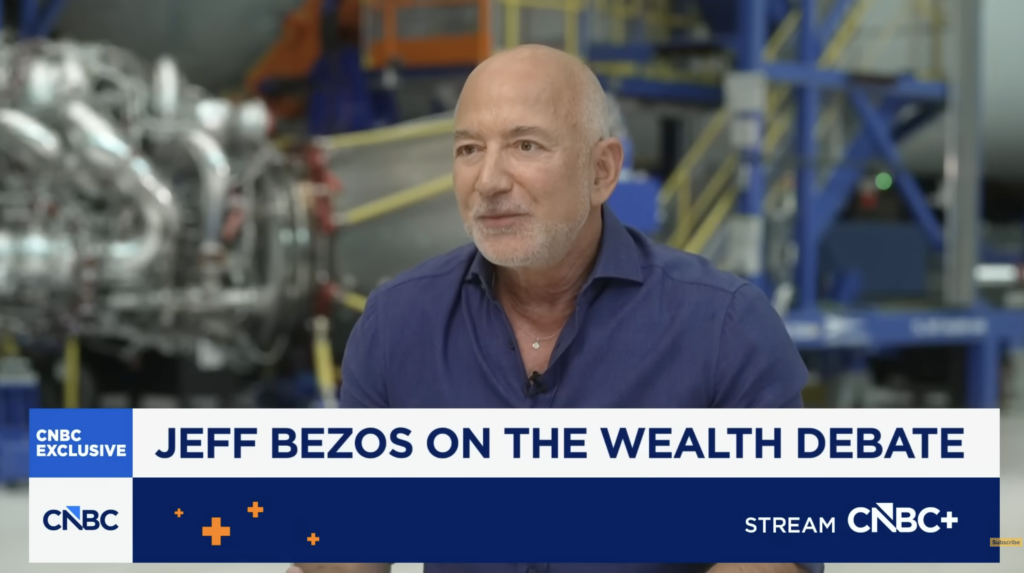
Jeff Bezos, the world’s fourth richest man with a personal wealth of approximately $280 billion, gave an interview on CNBC this week arguing, seemingly on behalf of ordinary working people, that a nurse in Queens earning $75,000 a year should not be paying over $1,000 a month in taxes.
Gary’s response is to take the argument apart carefully.
The context matters. A ballot on adopting a wealth tax is coming in California in November, and newly elected New York Mayor Zohran Mamdani is aggressively trying to tax the rich. The wealthy are paying attention, and Bezos’s CNBC appearance is part of their pushback.
Bezos’s argument: a nurse earning $75,000 pays over $12,000 in taxes annually — money she could be spending on rent or groceries. Gary identifies the mechanics immediately. Bezos chose $75,000 deliberately — close to the American average, so most viewers hear “that’s me.” He then attaches a vivid figure — $1,000 a month — and implicitly offers it as a prize for agreeing with him.
The problem is that this is a conjuring trick. Cutting taxes on workers is not a substitute for taxing billionaires more. The money has to come from somewhere. Gary’s analogy: it is like being at a restaurant with someone who is loaded, asking them to cover the bill, and being told — “how about neither of us pays?”
We can stop growing wealth inequality.
When pressed — shouldn’t you pay more to fund the cuts? — Bezos deploys a second argument: the real problem is government waste and “a skills issue” in government, he uses the phrase seven times.
Gary’s responds that reducing government waste and improving efficiency are not wrong, but it is meaningless because absolutely everyone already agrees with it. Every politician in history has made the same promise. If it were simply a matter of deciding to do it, it would have been done decades ago.
What the argument actually does is construct a new villain to replace the billionaire. The implicit message: the problem is not that I have $280 billion and pay almost no tax — the problem is that government is incompetent. A bait-and-switch that substitutes a limited, manageable problem for one that is structural and far more significant.
Gary identifies a third strand: exploiting the confusion between millionaires and billionaires. When Gary or Zucman says “tax the very rich,” a fraction of the audience hears “tax me.” A billion is a thousand times larger than a million, but ordinary language flattens the distinction — and it is consistently weaponised to make proposals aimed at the ultra-wealthy sound like threats to anyone who has ever done reasonably well.
This is why Gary has been so insistent on “Tax Wealth Not Work.” It is not just a slogan — it is an answer to the bait-and-switch, separating the taxation of labour income from the taxation of accumulated wealth.
Amazon uses “the five whys” to diagnose the cause of problems in their business. Jeff Bezos mentions it as a way to diagnose the problems in government.
In response Gary uses it to diagnose the inequality problem.
Why are living standards falling? Because people cannot afford housing or a secure financial future. Why? Because asset prices keep rising faster than wages. Why? Because an extremely wealthy class is using its surplus income to buy everything. Why does that class exist? Because in the 1980s, governments stopped taxing the rich effectively. Why did that happen? Because Thatcher and Reagan won a public argument — convincing people that letting wealth accumulate at the top would benefit everyone.
And why did they win? Because we forgot something our grandparents understood: that the distribution of wealth matters, not just its total level. The post-war generation built tax systems specifically designed to prevent extreme inequality from recurring. Their children and grandchildren, raised in prosperity, forgot why those systems existed — and voted to dismantle them.
Gary closes with a source of hope. The fact that the fourth richest man in the world feels compelled to go on television and argue he should not be taxed is itself a signal that the movement is working.
When Gary began working on inequality in 2011, nobody was interested. For the better part of a decade the argument was ignored, then laughed at — he points to the moment on The Rest is Politics when Zack Polanski’s wealth tax proposal was dismissed as fringe, only for the channel to promptly produce seven Nobel Prize-winning economists and Gabriel Zucman. Now Bezos is buying newspapers, funding media, and making television appearances to fight the argument. That is not the behaviour of someone comfortable. It is the behaviour of someone who feels threatened.
The task now is to ensure the public understands one simple thing: if inequality keeps growing, ordinary people’s living standards will keep falling. The moment that becomes the default answer when you ask someone in the street why their life is getting harder, even a $280 billion fortune cannot hold back the tide.